

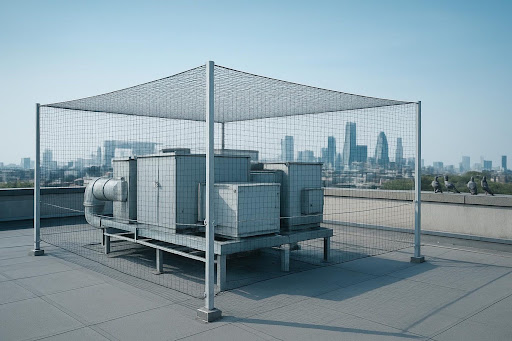
Commercial building owners and facilities managers install bird netting in London mainly to create a secure, non-lethal barrier that keeps pest birds away from vulnerable parts of a building and its systems. London’s large roof areas and closely packed urban buildings give feral pigeons and growing gull colonies many places to roost and nest. Without proper control, these birds can damage structures, soil outside walls, block roof drainage, and create biological hazards that affect workplace safety and legal duties.
Point-based deterrents may simply cause birds to move a short distance along a parapet. By contrast, high-grade bird netting London commercial premises require can provide full exclusion across large or complicated areas. By closing off recesses, internal lightwells, and rooftop plant equipment, netting protects valuable assets from corrosive waste, cuts repeated cleaning costs, and helps commercial sites meet UK environmental and public health standards.
1. Prevents Pigeons, Gulls and Other Birds From Entering Restricted Areas
London rooftops increasingly act as substitute cliffs and nesting sites for feral pigeons and coastal gulls that have adapted to city life. Ornithological surveys show that urban gull numbers have continued to rise, turning commercial flat roofs into regular breeding areas for successive generations. Netting stops this from taking hold by closing off the sheltered high points, internal ledges, and steelwork that birds choose for overnight roosting and nesting.
When birds enter partly enclosed commercial areas, they can cause serious disruption. Loading entrances, ventilation intakes, open courtyards, and plant enclosures can quickly become occupied. Correctly tensioned netting keeps birds out of these areas from the start. This helps avoid animal welfare incidents, business interruptions, and the difficult task of removing established flocks from active workplaces.
2. Reduces Droppings, Nesting and Bird-Related Damage
Bird droppings, also called guano, are much more than a visual problem. They can cause serious chemical and physical damage to modern and historic building exteriors. Guano contains uric acid, phosphates, ammonia, potassium, and chlorides. On porous materials such as limestone, Portland stone, and lime mortar, which are common across London’s commercial areas, these substances can cause salt deposits, surface wear, and spalling. On modern roof membranes, regular contact with acidic guano can weaken protective coatings, speed up deterioration, and lead to early roof failure.
Nesting material also creates ongoing risks for building services. Pigeons and gulls push twigs, rubbish, and feathers into narrow drainage channels, parapet gutters, downpipes, and rainwater outlets. During heavy London rain, blocked outlets can quickly cause water to collect. This may lead to collapsed ceilings, damaged stock, and costly insurance claims. Netting keeps nesting material out of these important drainage routes.
3. Supports Hygiene and Workplace Safety
Bird waste creates recognised biological risks that commercial property duty holders must manage under UK health and safety rules. The Health and Safety Executive (HSE) identifies dried bird droppings as a possible source of diseases such as psittacosis, histoplasmosis, and salmonellosis. These illnesses can cause serious respiratory problems and pneumonia in maintenance workers and building occupants. Netting greatly reduces the amount of contaminated dust that can enter air handling equipment, helping protect indoor air quality.
Guano on external fire escapes, maintenance walkways, suspended gantries, and plant access ladders can also turn damp surfaces into serious slip risks. Facilities staff servicing rooftop chillers, lifts, and communications equipment may face unsafe conditions if access routes are covered in waste. Exclusion netting helps keep these routes clean and usable, reducing the need for repeated specialist cleaning teams wearing full personal protective equipment.
4. Protects Façades, Equipment and Building Services
Commercial properties depend on exposed plant equipment such as chillers, heat pumps, air handling units, ductwork, and cable trays. Pigeons and gulls often use the shelter and leftover heat around these systems. They can soil condenser fins, damage sensor wires, place flammable nesting material around electric motors, and block ventilation openings. These problems can cause equipment to overheat and suffer sudden failure.
Commercial buildings with solar photovoltaic (PV) panels can also lose energy production because of bird activity. Birds that roost or nest beneath panels may damage wiring and leave thick layers of guano on the glass. Even partial coverage can reduce power generation. Netting places a protective boundary around mechanical, electrical, and renewable energy equipment. This helps extend equipment life and reduces unexpected system shutdowns.
5. Provides a Long-Term, Passive Bird Control Barrier
Many older bird control methods depend on active scaring, harassment, or chemical products. These approaches need regular replacement, adjustment, or staff attention. Urban birds can become used to repeated visual or sound warnings quite quickly, so the effect of these devices may decline within weeks. Netting works differently. It is a passive physical barrier that works continuously without electricity, chemicals, or regular human control.
When fitted with the correct tension and marine-grade fixings, heavy-duty commercial netting can provide reliable exclusion for ten years or more. It uses no ongoing power, creates no background noise, and provides steady performance throughout the year. This long service life makes netting a predictable and cost-effective choice for commercial property managers.
Where Is Bird Netting Used on Commercial Buildings?
Bird netting can be adapted to enclose almost any commercial outside area or partly exposed internal space. It is not limited to one standard shape or layout. Commercial netting can act as a physical curtain across a wide horizontal roof, hang vertically over a recessed façade, or close off an area with an unusual shape.
London facilities managers use netting on many types of property. The fixing layout, cable tension, and mesh size can be selected to suit the building’s use, structure, and appearance.
1. Warehouses, Distribution Centres and Industrial Units
Logistics centres, freight terminals, and industrial units often have high eaves, exposed steel purlins, and large delivery bays. These sheltered spaces are attractive nesting areas for feral pigeons. Netting is often fitted horizontally across the ceiling structure. This prevents birds from sitting on high beams and dropping waste onto goods, automated picking machinery, and staff below.
Keeping stock clean is a basic requirement for large distribution centres. Netting canopies over open loading docks stop birds from moving from the yard into the warehouse. This supports smooth delivery work, protects packaging, and helps meet the storage standards required by major retailers and third-party logistics companies.
2. Retail Premises, Offices and Shopping Centres
Retail buildings and busy office developments need to maintain a clean street appearance. This supports brand image, tenant satisfaction, and visitor numbers. Bird droppings running down glazed façades, entrance porticos, and illuminated signs can quickly harm customer perceptions. In multi-let office buildings, this may also lead to disputes between tenants and landlords.
In shopping centres and office atriums, netting can cover decorative canopies, recessed windows, internal courtyards, and colonnades. The mesh is pulled tight to keep its visual effect low while stopping birds from gathering over walkways, outdoor seating, and entrances.
3. Loading Bays, Courtyards, Atriums and Covered Walkways
Covered outside areas, including basement vehicle ramps, internal delivery courtyards, covered paths, and deep atriums, often suffer from repeated bird activity. Overhead shelter, limited wind, and regular vehicle movement create conditions where urban birds can roost throughout the winter.
Vertical netting drops and horizontal canopy nets can close these open spaces. By blocking the full ceiling area, building managers stop birds from using beams, drainage trays, and lighting trusses as perches. This protects delivery workers, waste teams, and facilities staff working below.
4. Roof Spaces, Balconies, Plant Rooms and Solar Panels
Modern London flat roofs contain a large amount of plant equipment. Air-conditioning condensers, variable refrigerant flow (VRF) units, boiler flues, and lift motor rooms all have sheltered gaps that attract nesting birds. Netting can form a complete cage around roof plant or be fitted as boundary skirts around selected service areas.
Commercial balconies, recessed terraces, and large solar PV arrays also need physical protection. Netting keeps pigeons out of the warm, dark spaces beneath panels. It prevents damage to wiring and keeps access available for facilities contractors carrying out routine plant work.
5. Food, Hospitality and Healthcare Facilities
Food factories, commercial kitchens, outdoor restaurant terraces, and healthcare sites work under strict hygiene rules. Under UK food safety law and Food Standards Agency (FSA) guidance, a bird infestation that creates a serious risk of food contamination can lead to a Hygiene Emergency Prohibition Notice. This may result in a forced closure, large financial penalties, and long-term damage to the business name.
Healthcare sites must protect patients with weakened immune systems from environmental pathogens such as Aspergillus and Salmonella, both of which can be present in bird waste. Netting waste areas, kitchen delivery points, hospital plant roofs, and ambulance bays helps control this risk and supports compliance during environmental health inspections.
6. Historic Buildings and Properties in London Conservation Areas
Central London has a very high number of historic, listed, and conservation-managed commercial buildings. Victorian brick, neoclassical Portland stone, decorative cornices, and detailed friezes are valuable parts of the city’s heritage. They are also highly vulnerable to the corrosive effects of pigeon guano.
Netting in conservation areas needs careful planning. Specialist contractors may use discreet mesh in a matching shade, such as stone-coloured or translucent netting. They can also use fixings placed in mortar joints rather than in the faces of dressed stone. This protects the appearance and historic material of the building while meeting local planning requirements.
How Does Bird Netting Compare With Other Bird Control Methods?
Commercial facilities managers can choose from several Anti-Vermin Bird Control (AVCL) systems. These include mechanical spikes, post-and-wire systems, optical gels, sound deterrents, and electric tracks. Each option suits different building shapes and levels of bird activity. The right choice depends on the number of birds, the shape of the site, and how visible the equipment can be.
Comparing netting with these other options helps property managers choose a system that gives lasting and cost-effective protection instead of short-term or limited displacement.
Bird Netting Versus Bird Spikes
Bird spikes use blunt stainless steel wires fixed to a UV-resistant polycarbonate base. They are intended to make narrow, straight features uncomfortable for birds to use. Typical locations include window sills, parapet edges, thin ledges, and the tops of signs. They are fairly quick to fit with neutral-cure adhesive and can work well against perching birds where bird numbers are low or moderate.
Spikes are less suitable for deep recesses, large roof areas, or locations where birds are nesting. Under heavy pressure, pigeons and gulls may place twigs and rubbish between the wires and use the spikes as a support for their nests. Spikes also cannot close off large spaces such as loading bays, plant rooms, or internal atriums. In these locations, netting is usually the practical way to provide full coverage.
Bird Netting Versus Bird Wire and Post Systems
Post-and-wire systems use very thin stainless steel wires held between small springs and stainless steel posts. The posts are fixed at regular intervals. When a bird tries to land, the spring moves under its weight and creates an unstable surface. Because the wires are hard to see, this method is often chosen for historic façades, premium retail buildings, and listed properties where visible netting may not be acceptable.
These systems suit narrow ledges with light bird activity, but their use is limited. They do not stop birds entering recessed areas, sitting on plant equipment, or nesting in roof gullies. Netting closes a much larger space and gives full exclusion where spring wires cannot deal with a large or established flock.
Bird Netting Versus Gels, Electric Tracks and Coils
Optical bird gels and slim electric tracks are discreet options for ledges and parapets. Optical gels reflect ultraviolet light, which birds may see as a flame-like image, and give off an unpleasant scent. Electric tracks provide a harmless, low-energy pulse that discourages birds from landing. Stainless steel coils may also be used along long exposed stone balustrades to make perching difficult.
These methods can work well for specific straight features, but they need ongoing care. Optical gels collect soot, dust, and other city pollution. They lose their reflective effect and usually need replacing every two or three years. Gel products can also seep into porous historic stone and leave permanent marks. Electric tracks need a constant power supply and regular electrical checks. Netting is a clean, passive barrier that can close off complete architectural areas without the repeated work linked to electronic or chemical systems.
Why Visual, Sonic and Ultrasonic Deterrents May Provide Limited Results
Visual scare devices, including plastic birds of prey, reflective tape, and predator kites, are common low-cost attempts at bird control. Sonic devices play distress calls or artificial predator sounds. In busy commercial and industrial locations, pigeons and gulls often become used to these signals quickly. Once they learn that a plastic decoy does not move like a real predator or that a recording is not followed by danger, they may ignore it.
Ultrasonic devices operate above the range of human hearing and face similar limits. High-frequency sound loses strength quickly in open air, can be blocked or redirected by building services, and cannot reach deeply enclosed machinery areas. These devices also cannot legally be used where bats are present because of UK wildlife protection rules. In dense London commercial buildings, sensory deterrents often provide a short-lived result. Structural netting gives a direct physical barrier.
Choosing Exclusion for Heavy Bird Pressure and Enclosed Spaces
Industry professionals generally divide bird activity into three levels:
- Light Pressure: Birds use ledges and roofs from time to time as daytime observation points.
- Medium Pressure: Flocks gather regularly to feed, rest, and interact during the day.
- Heavy Pressure: Birds sleep, mate, build nests, and raise chicks in sheltered parts of the building.
Where bird pressure is heavy, comfort deterrents such as spikes and wires, along with sound or visual scarers, often fail. The urge to return to a good nesting site is stronger than the inconvenience caused by spikes or unfamiliar sounds. In heavily affected areas and enclosed spaces such as loading bays, plant courtyards, and deep roof parapets, structural bird netting is the only option that can provide full exclusion and stop the infestation cycle for good.
What Should Businesses Check Before Installing Bird Netting in London?
Arranging an industrial bird netting project on a London commercial building involves access planning, structural checks, and legal coordination. The capital has a particularly demanding built environment, with historic masonry, busy pavements, close property lines, and complicated roof structures. These conditions call for careful planning before work begins.
Building owners and facilities teams should complete checks across several technical and management areas before any installation work starts.
1. Building Access, Roof Safety and Working-At-Height Requirements
Commercial netting installation involves work at height and may carry serious risks. London buildings often create access problems. Narrow side streets may prevent mobile elevated work platforms (MEWPs) from parking. Heavy pedestrian traffic can limit ground-level work areas, while delicate architectural details may prevent the use of large scaffolding systems.
Building managers should check that the installation company is qualified under the Work at Height Regulations 2005. Contractors may need credentials such as IRATA (Industrial Rope Access Trade Association) certification for abseil teams or PASMA and IPAF certification for mobile platform work. Roof safety equipment, including certified horizontal lifelines, anchor points, and parapet edge protection, should be checked before technicians start.
2. Planning, Landlord and Conservation-Area Considerations
Standard netting on a non-listed commercial building will not usually need formal planning permission. Different rules may apply in London conservation areas. For a Grade I, Grade II*, or Grade II listed building, permanent mechanical fixings into the building fabric will generally need Listed Building Consent (LBC) from the local council.
Commercial tenants should also check their full repairing lease and obtain the landlord’s written consent before drilling anchors into a façade or roof. Ignoring the planning authority or landlord may result in an enforcement notice requiring the complete removal of the system and expensive repairs to the outside of the building.
3. Existing Nests and Protected Wild Bird Requirements
The time of year affects the legal position of a bird netting project. The UK breeding season generally runs from February to August. During these months, active nests with eggs or dependent chicks are more likely to be present.
The client should check that the contractor carries out a full survey before installation. If an active nest is found on the roof or a ledge, work in that area must stop immediately. It may only restart after the chicks have left naturally and the nest has been abandoned. Planning work with an experienced team like Rope Access in London for late autumn or winter can lower the chance of delays caused by active nests.
4. Fire Exits, Ventilation, Drainage and Maintenance Access
A badly planned netting system may interfere with building services. Netting must not block external fire escape ladders, smoke ventilation louvres, automatic smoke vents, or emergency roof hatches. It must also leave enough airflow for HVAC condensers and heat recovery air handling units. Restricted airflow can cause overheating and may affect equipment warranties.
The design should include access points for future servicing. Heavy-duty marine-grade zips, net clips, and access hatches can be fitted above gutters, rainwater outlets, cable trays, and chiller inspection panels. These openings allow maintenance staff to reach equipment and remove roof debris without cutting the mesh and weakening the barrier.
5. The Contractor’s Insurance, Risk Assessment and Method Statement
Commercial work at height in a busy city creates risks for workers, visitors, and the public. Clients should check that the contractor has suitable insurance. A contractor should carry at least £5 million to £10 million of Public and Products Liability Insurance, together with Employers’ Liability Insurance.
The contractor should also provide site-specific Risk Assessments and Method Statements (RAMS) before arriving on site. These documents should explain:
- How drop zones and public protection will be managed over busy London pavements.
- What rescue arrangements are in place for rope-access technicians or platform operators.
- How masonry anchor pull tests will check the strength of the building material.
- Which flame-retardant materials will be used to meet the building’s internal and external fire safety plans.
Why Choose Professional Bird Netting Installation for a Commercial Property?
Basic bird netting is available as a raw product, but a commercial installation needs careful engineering. Industrial nets carry tension across wide gaps, face strong wind during winter storms, and must be secured to different materials, from old London stock brick to modern aluminium cladding.
Using qualified installation specialists helps the finished system provide full exclusion, meet legal requirements, last for many years, and have little effect on the appearance of the property.
Accurate Surveys for Complex London Buildings
A professional project starts with a detailed site survey. London commercial buildings rarely have simple, regular shapes. They may include setbacks, uneven roof gullies, decorative pediments, old chimneys, and large areas of plant equipment. A trained surveyor checks:
- The bird species present, the size of the population, and the level of activity, such as nesting or perching.
- The condition of the building material and whether the fixings need to enter structural steel, concrete, or lime mortar joints.
- Local wind loads, particularly on tall buildings and wide plant enclosures.
- The best fixing pattern, cable route, and access hatch positions for future maintenance.
This preparation helps the completed system fit the building closely. It reduces loose edges, excess wind drag, and gaps through which birds could enter.
Safe Access Equipment and Compliant Installation Practices
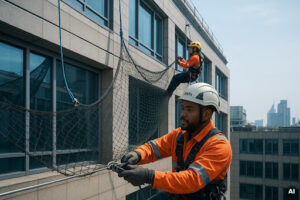
Professional London bird control contractors often have specialist access teams. In central locations, multi-storey scaffolding may cost a great deal, disrupt traffic, or require complicated pavement licences from the local council. Certified IRATA rope-access technicians can often work from existing roof anchors instead. They can complete accurate installations while causing little disruption to businesses at ground level.
Where mobile access is suitable, certified operators may use truck-mounted MEWPs, spider lifts, and modular aluminium towers. Professional teams carry out the work in line with the Health and Safety at Work etc. Act 1974. They manage ground exclusion zones and reduce the risk of falling equipment or materials over public walkways.
Discreet Designs for Offices, Retail Façades and Heritage Properties
Keeping birds out without changing the appearance of a valuable commercial property requires skill. Experienced installers can hide fixings behind parapet walls, line stainless steel cables with existing mortar joints, and pull the mesh tight so it is almost invisible from street level.
Matching the mesh to the surrounding building also reduces its visual effect. Stone-coloured netting can blend with masonry, black mesh can disappear into shaded eaves, and clear translucent mesh can suit glazed atriums. This helps preserve the appearance of headquarters, luxury shops, and historic buildings.
Integrated Solutions for Large-Scale Sites and Multiple Buildings
Large commercial estates, including business parks, hospital campuses, transport interchanges, and major logistics sites, need a site-wide plan. Treating one roof gully may simply cause birds to move a short distance to an unprotected chiller compound on another building.
Professional bird control companies can create a plan for the whole estate. They may combine wide netting over main roof plant areas with spikes on outer ledges, spring wires on decorative cornices, and solar skirts around PV panels. This layered approach protects the full property rather than a few isolated spots.
Ongoing Maintenance and Bird Control Support
Commercial bird netting should not be installed and then forgotten. Strong winter winds, changes in temperature, and contact with contractors working on plant can loosen or damage the system. Established contractors may offer Service Level Agreements (SLAs) and Planned Preventative Maintenance (PPM) packages.
Under a planned service contract, trained technicians inspect the mesh at set intervals, check cable tension with calibrated gauges, remove airborne debris, clear gutters, service access zips, and check that birds or other wildlife have not entered the enclosure. Regular records also help property owners meet their ongoing legal duty of care.
