

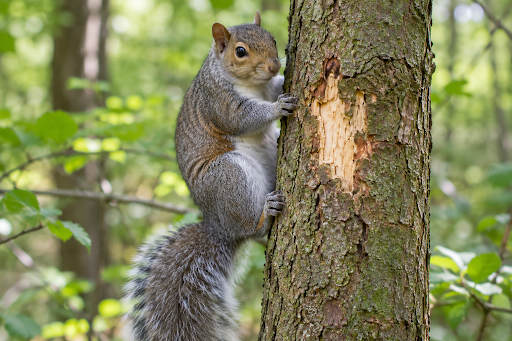
Missing bark on a woodland tree can be easy to overlook, especially when the canopy still appears healthy. However, repeated stripping can leave lasting damage that affects the tree’s strength, growth and future timber quality. For woodland owners and people managing larger gardens, recognising the cause early makes it easier to decide what action is appropriate.
Before choosing a squirrel trap, establish whether grey squirrels are responsible and how widespread the damage has become. The location of stripped bark, evidence of recent activity and the species of trees affected can help build that picture. Control decisions should follow a site assessment, including consideration of other wildlife, rather than being based on an occasional squirrel sighting.
Understand Why Bark Damage Matters
Grey squirrels strip bark from trunks and branches, exposing the tissues beneath. Forest Research explains that the resulting wounds can lead to timber staining, decay and structural defects. Severely weakened stems may break, while bark removed around the full circumference of a stem or branch can kill the section above it. Beech and sycamore are particularly susceptible, although oak and several conifer species can also suffer serious damage.
This makes the position and extent of a wound important. A small patch on one branch is different from repeated damage around the main stem. Where damage affects a tree beside a path, building or regularly used area, seek an arborist’s assessment if there are concerns about its condition. Do not assume that a leafy canopy rules out structural problems.
Check the Pattern Before Identifying the Culprit
Squirrels can remove bark anywhere from the base of a tree into its canopy. Damage close to the ground is less straightforward to identify because other mammals may leave similar signs. Forest Research notes that squirrel bark stripping on the lowest part of a stem can be confused with rabbit damage.
Look at several affected trees rather than relying on one wound. Note the height of the damage, whether bark has been gnawed or rubbed away, and any visible tooth marks. Photographs of the whole tree and close views of the damaged area will be more useful than a close-up alone. The Forestry Commission’s guide to identifying squirrel and deer damage provides photographs and descriptions to help distinguish common causes.
Keep a Record of Fresh Damage
A simple record helps separate an ongoing problem from evidence of previous activity. Mark affected trees on a map and photograph the same areas during later inspections. Include the date, tree species and whether the wound appears to have expanded. This gives a woodland adviser something concrete to assess and helps prevent old damage being counted repeatedly.
For a manageable inspection routine, follow the same route through the woodland and revisit the same trees. Include apparently unaffected trees nearby so that you can see whether the problem is spreading. An occasional walk without records may reveal damage, but it will tell you much less about how quickly conditions are changing.
Consider the Wildlife Around the Site
Trap selection must account for animals other than grey squirrels. Check whether red squirrels or pine martens occur locally, including near the woodland boundary. Current Forestry Commission guidance for England says lethal traps must not be used where these protected species are present or near known populations. Its management guidance specifies single-capture cage traps in areas where red squirrels or pine martens are present.
This is a reason to get local advice before buying equipment. A woodland manager or conservation organisation may know about nearby populations that you have not personally seen. Public access, pets and the ability to inspect equipment reliably also need to be considered when deciding whether a control programme is practical.
Plan Control Before Setting Equipment
Live-capture traps and lethal spring traps have different operating requirements. Where spring traps are used, check that the model is approved for the intended species and use in the relevant UK nation, and follow its approval conditions and manufacturer’s instructions. Equipment should be selected and operated by someone who understands both its limitations and the welfare responsibilities involved.
A live-capture trap does not provide a catch-and-release solution. Government guidance states that captured grey squirrels must not be released and must be killed humanely. Anyone considering live trapping therefore needs a lawful, humane plan for dealing with a capture before setting the trap. If that cannot be provided competently, use a suitably experienced professional.
Measure Progress Through Tree Condition
Continue inspecting trees after management begins. Record whether new bark wounds are appearing, whether existing damage is extending and which parts of the woodland remain affected. Catch totals alone cannot tell you whether vulnerable trees are receiving adequate protection.
Neighbouring land also matters because squirrels move across property boundaries. Sharing observations and coordinating management can make the work more effective than treating each woodland in isolation. The Forestry Commission recommends both cooperation with neighbours and repeated assessments of squirrel impact.
Keep the objective specific: reducing fresh damage to the trees you are trying to protect. Consistent observations, appropriate advice and a planned response provide a sounder basis for decisions than reacting to sightings alone.
